Yara Wagner · 9 November 2026
Poland Advances Lecture Hall Accessibility in Tandem with Secondary Exam Overhauls and International Student Influx
Poland has rolled out targeted updates to lecture hall infrastructure across public universities as part of a coordinated effort that also encompasses changes to the matura secondary school exit exams and accommodations for a growing cohort of international enrollees, with several measures scheduled to take full effect by November 2026.
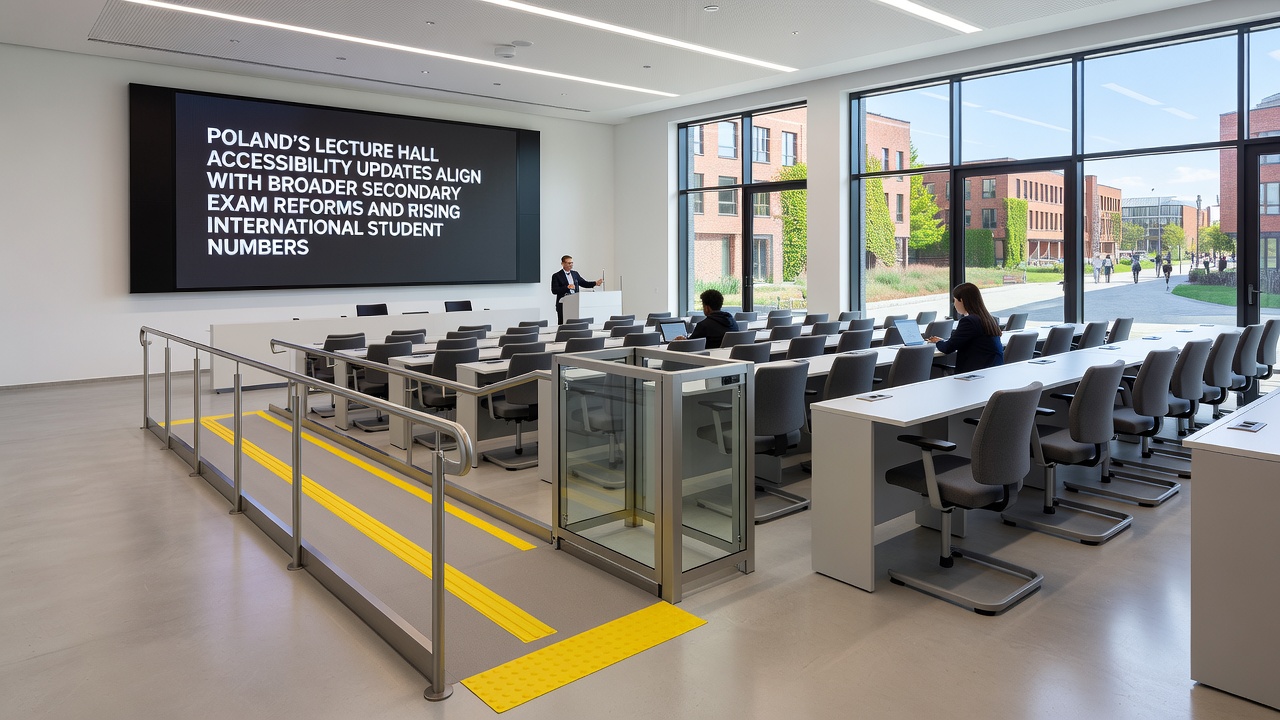
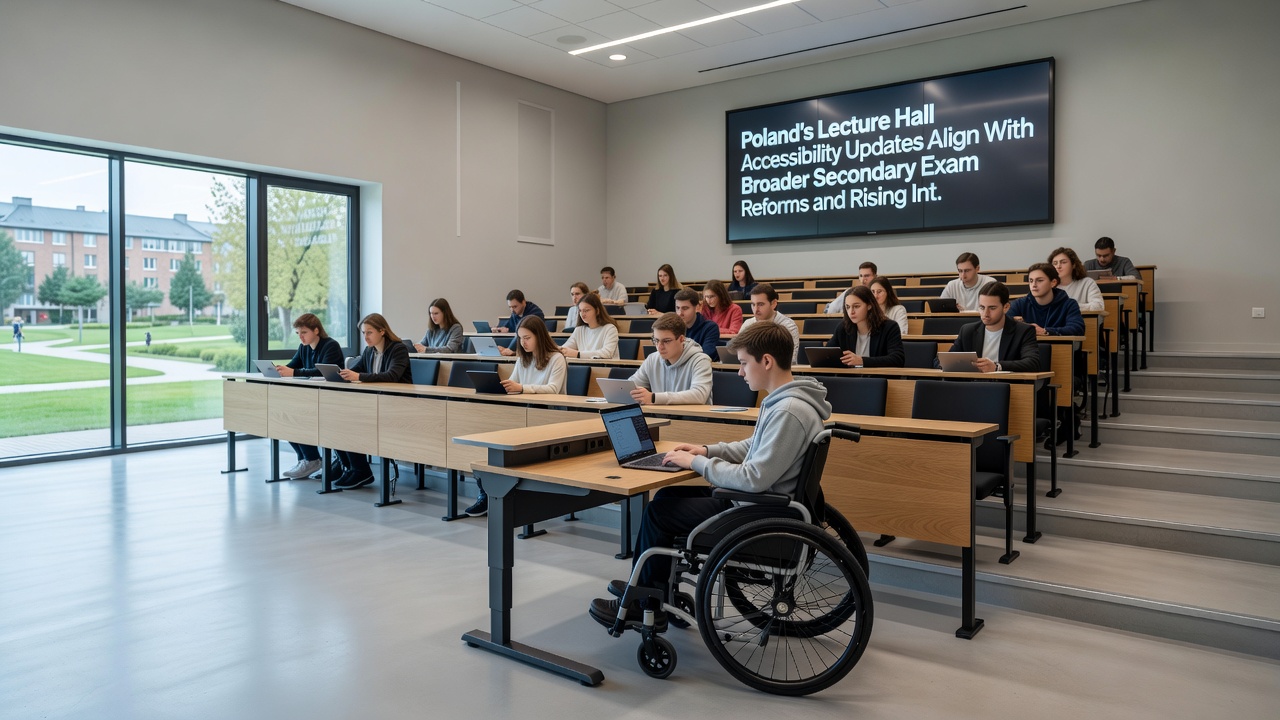
These accessibility modifications include installation of automatic doors, adjustable podiums, induction loops for hearing assistance, and expanded seating arrangements that meet EU disability standards, while parallel exam reforms introduce digital testing options and extended time provisions for students with documented needs.
Current Scope of Lecture Hall Modifications
Ministry of Science and Higher Education records show that more than 180 lecture halls at 45 institutions received upgrades during the 2024-2025 academic cycle, with funding drawn from both national budgets and European Regional Development Fund allocations; data from the Central Statistical Office of Poland indicate that institutions in Warsaw, Kraków, and Wrocław accounted for 62 percent of completed projects.
Researchers at the University of Warsaw documented that retrofitted halls now support an average increase of 15 percent in usable capacity for students requiring mobility aids, and similar patterns appear in technical universities where laboratory-adjacent lecture spaces received additional electrical outlets and lowered sight-line barriers.
Secondary Exam Reforms and Accessibility Provisions
Revisions to the matura examinations, administered by the Central Examination Board, now incorporate screen-reader compatible formats and separate testing rooms for candidates with sensory impairments, a shift that aligns directly with the physical changes occurring in higher-education venues; enrollment data compiled by the Polish Rectors Conference reveal that 78 percent of 2025 matura takers who qualified for accommodations pursued university admission the following year.
Because these exam adjustments reduce barriers at the point of entry, universities have prioritized matching infrastructure so that admitted students encounter consistent support once they reach lecture settings, and observers note that this continuity reduces dropout rates among students who previously cited physical access as a primary obstacle.
Growth in International Enrollment Figures
According to figures released by the Foundation for the Development of the Education System, international student numbers in Poland rose from 54,000 in 2019 to 89,000 in 2025, with the largest cohorts arriving from Ukraine, Belarus, India, and Nigeria; this expansion has prompted institutions to ensure that lecture facilities accommodate language-support technology and varied mobility requirements simultaneously.
One study conducted by the Conference of Rectors of Academic Schools in Poland found that universities reporting the highest international intake also completed accessibility projects earliest, suggesting a direct operational link between enrollment trends and infrastructure priorities, while November 2026 marks the deadline for full compliance with updated national accessibility benchmarks tied to these demographics.
Integration of Reforms Across Educational Levels
Policy documents from the Ministry of National Education outline how secondary-level digital exam platforms feed student accommodation profiles directly into university admission systems, allowing lecture-hall scheduling software to pre-assign accessible seats without separate applications; this data-sharing mechanism reduces administrative delays and ensures that students who used extended time on matura exams receive equivalent provisions in university courses.
European Commission education statistics place Poland among the top five EU member states for the rate of accessibility retrofits completed between 2023 and 2025, and the same reports highlight that countries with comparable international student growth, such as the Netherlands and Germany, have adopted parallel alignment strategies between secondary certification and tertiary facilities.
Regional Variations and Funding Mechanisms
Institutions in eastern Poland received supplementary grants through cross-border cooperation programs with Lithuania and Ukraine, enabling smaller universities to install captioning systems and tactile signage that larger urban campuses had already implemented; these regional differences have narrowed as national standards take effect ahead of the 2026 timeline.
Statistics published by the OECD education directorate show that Poland's per-student spending on accessibility infrastructure increased 34 percent between 2022 and 2025, a rise that tracks closely with the percentage of international students requiring documented support services, and analysts attribute part of the funding stability to consistent drawdowns from EU cohesion funds allocated specifically for inclusive education.
Conclusion
The convergence of lecture-hall accessibility upgrades, secondary exam reforms, and rising international enrollment forms a single policy thread that Polish higher-education institutions continue to implement, with measurable milestones set for November 2026; continued monitoring by the Central Statistical Office and international bodies will track whether these coordinated changes sustain enrollment gains and improve completion rates across demographic groups.